
Which Marine Resources Should We Be Managing?
Are we just talking about the narrow band of water around islands that comprise the Marine Parks in Peninsular Malaysia – mainly home to coral reefs? Or are we talking about other, interconnected marine ecosystems?
THREE IMPORTANT MARINE ECOSYSTEMS IN MALAYSIA
The phrase “marine resources” has many different interpretations.
To a merchant seaman, it could simply mean free and open access to seaways. To a mining company, it could mean undersea resources such as hydrocarbons, precious metals and so on. To a fisheries expert, it could mean the stocks of fish on which communities worldwide rely for their main source of dietary protein. To a resort operator – the very attraction that brings people to their door.
So let me start off by saying that 30x30 Malaysia focuses primarily on three marine ecosystems: coral reefs; seagrass beds; and mangroves. Even this definition is somewhat arbitrary. Some might argue that mangroves are coastal; others might argue for the inclusion of mudflats and other similar ecosystems.

We have since come to understand that coral reefs don't exist in isolation, which obviously changes the way we look at "the sea". Coral reefs are deeply linked to other marine ecosystems – particularly seagrass beds and mangroves. Some might even say that they are but one habitat – with species moving between them as they move between different stages of their lifecycle. Some move between ecosystems to feed, some to breed, some to mature.
So surely, we should be looking at these ecosystems, or habitats, in a joined up, holistic manner, right?

No.
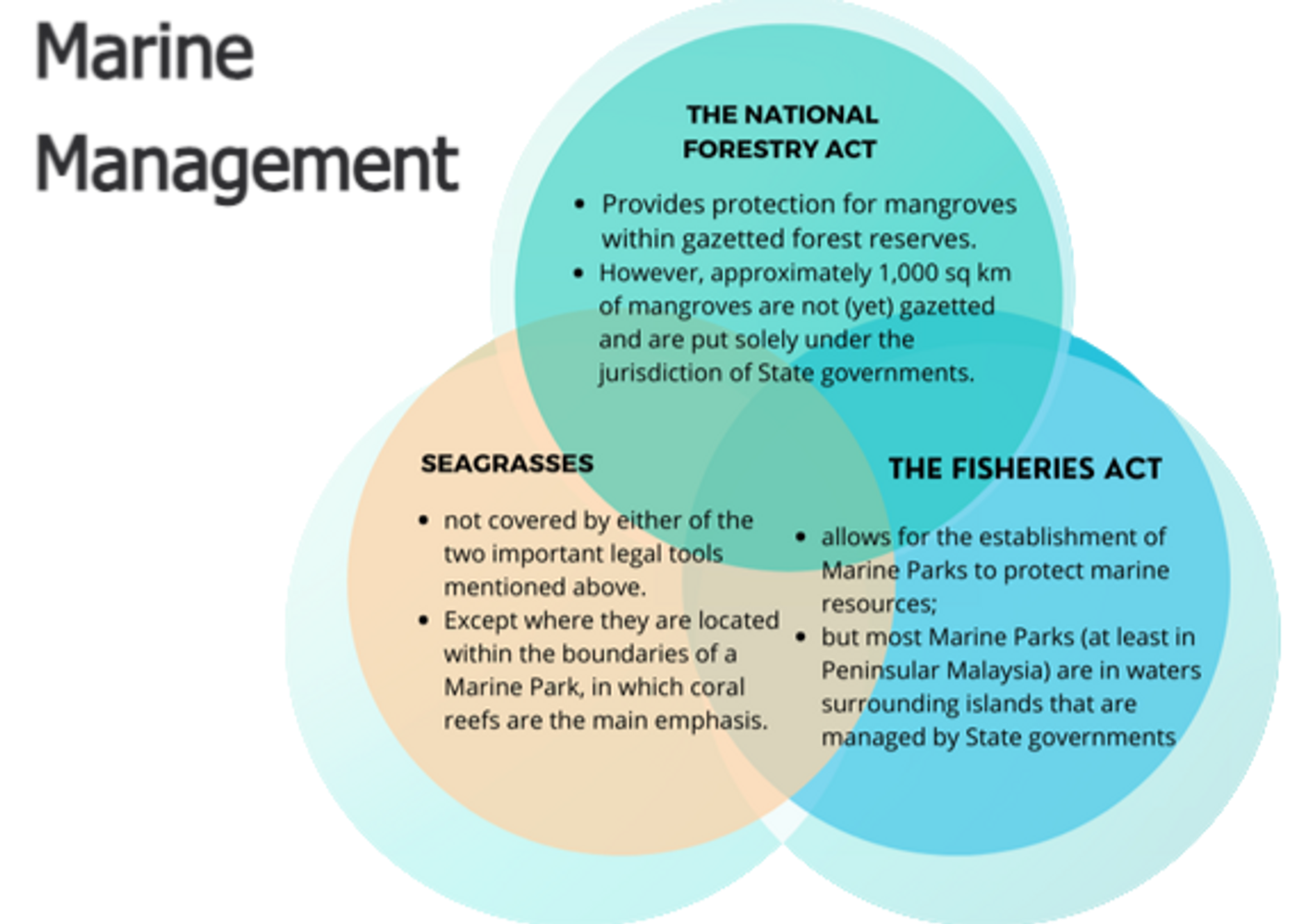
The reality is that management is fragmented and that there is no holistic management of these critical habitats:
- The National Forestry Act provides protection for mangroves within gazetted forest reserves. However, approximately 1,000 sq km of mangroves are not (yet) gazetted and are put solely under the jurisdiction of State governments.
- The Fisheries Act allows for the establishment of Marine Parks to protect marine resources; but most Marine Parks (at least in Peninsular Malaysia) are in waters surrounding islands that are managed by State governments.
- Seagrasses, on the other hand, are not covered by either of the two important legal tools mentioned above. Except where they are located within the boundaries of a Marine Park, in which coral reefs are the main emphasis.
CONNECTIVITY
We are now aware of two important axes of biological connectivity between these three ecosystems.
First, there is community connectivity– between different communities of each ecosystem. Taking coral reefs off the east coast of Peninsular Malaysia as an example, research suggests that the reefs in the south are connected to reefs in the north.
Research also suggests that the distance between “known reefs” (e.g. Tioman island to Tenggol island which is some 220km) is too far for coral larvae to travel before they become ready to settle and form a new colony. So the theory goes that there are “stepping stones” along the way – un-surveyed reefs that form a link between distant reefs.
WHY IS THIS IMPORTANT?
Well, consider that it is likely that reefs in the south provide new “seeds” (in the form of coral, fish and other larvae) to reefs in the north, allowing them to recover if badly damaged. But what would happen if the “stepping stones” were disrupted – because we don’t know where they are and so we can’t protect them.
No more larval flow, no more re-supply, with dire consequences for those northern reefs.
And then there is what I will call functional connectivity– whereby one ecosystem plays host to a particular species during different stages of the species' lifecycle, with the organism moving between each ecosystem at different periods of its life.
Looking again at the East coast of Peninsular Malaysia, this is “West-East” connectivity, moving from coastal mangroves through near coastal seagrass beds to coral reefs. Disrupt one of the ecosystems and you disrupt the entire life-cycle of the organism, again with dire consequences for populations.

INTEGRATING MANAGEMENT
We have come to the conclusion that it is essential to manage all three ecosystems using an integrated approach that protects both the North-South and the West-East connectivity.
Yes, it’s a big task – it will involve multiple jurisdictions (Federal or State) and multiple stakeholders (fishermen, local communities, tourism operators, shipping industry, etc).
But imagine we could make it work.
It could potentially improve food security for coastal and urban communities, improve livelihoods, protect biodiversity, provide for coastal protection against the coming challenges of climate change and even create economic opportunities in new forms of tourism. The challenges are immense, but the potential rewards are worth giving this a close look.
